Project details:
Architects: Rafael de la-Hoz Arquitectos and Hakim Benjelloun.
Location: Salé, Morocco
Construction: 2016 – 2024
Height: 250 meters
Floor area: 102,800 m²
Floors: 55
Client: FinanceCom Group (now O Capital Group)
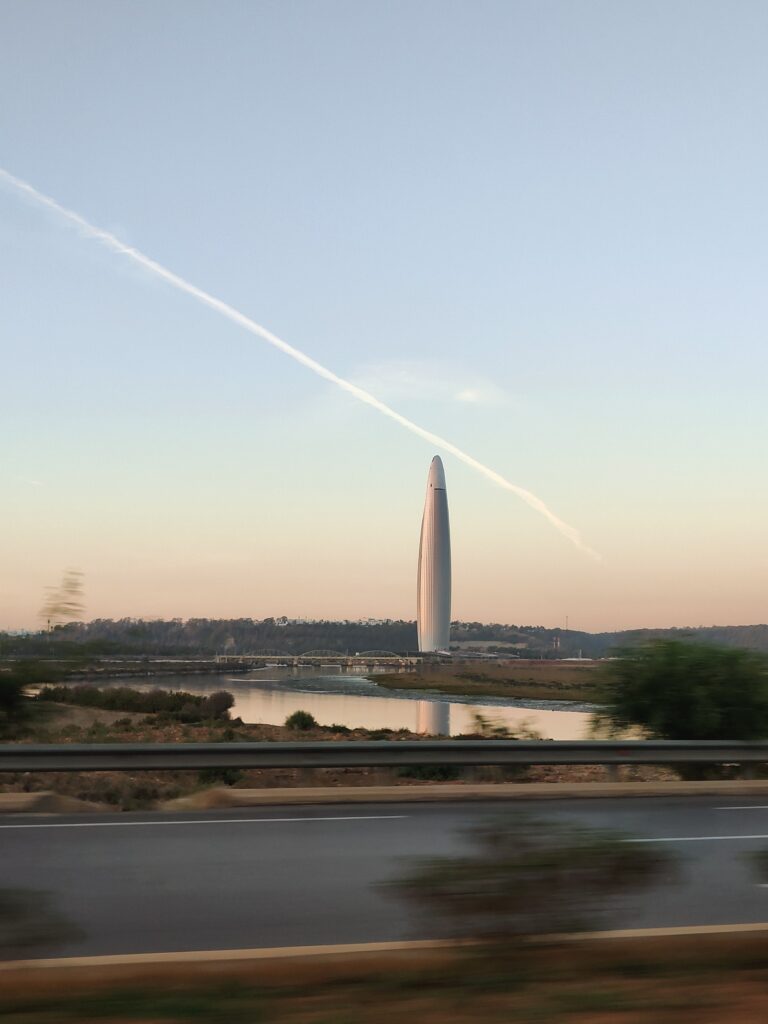
At 250 meters, the Mohammed VI Tower is now the tallest building in Morocco. Rising above the Bouregreg Valley between Rabat and Salé, it is reportedly visible from as far as 50 kilometers away, a presence designed by Rafael de la Hoz and Hakim Benjelloun that dominates the region’s skyline from nearly every angle of approach.
The instinct, faced with such a structure, is to be impressed. But scale alone answers little. A more useful question is not whether the tower is impressive, but why it needed to be tall in the first place. Is its height solving a problem, or performing one?
Height, historically
Skyscrapers emerged from constraints. As cities industrialized and populations concentrated, the price and scarcity of urban land made horizontal growth increasingly impractical. Building upward became an economic response to density, first in Chicago and then in Manhattan, where architects such as William Le Baron Jenney pioneered steel-frame construction that could support far greater heights than masonry alone allowed.
Height was, at that stage, inseparable from technological milestones. The steel skeleton freed façades from the load-bearing weight of stone. Each new record height announced genuine engineering advancement, from Louis Sullivan’s early expressions of verticality to the mid-century glass towers of the International Style, and later to structurally daring projects like Chicago’s Willis Tower, engineered by Fazlur Khan.
But height has never only been about land or engineering. By the late twentieth century, a third logic had firmly taken hold: height as branding. The Petronas Towers in Kuala Lumpur, briefly the tallest buildings in the world, were not a response to any particular land shortage in Malaysia. Nor was the Burj Khalifa a necessity dictated by Dubai’s geography. These towers were built to hold a title, to anchor a skyline, to announce a city or a nation’s arrival on a global stage. Height, in these cases, is disconnected from scarcity and instead becomes a form of rhetoric: a structure that speaks before it functions.
Almost every tower built today carries some mixture of these three logics: scarcity, engineering ambition, and symbolic branding. The Mohammed VI Tower is no exception, and understanding which of these forces is actually driving it, is the real work of reading this project.
Assessing the argument for height
Starting with scarcity, because it is the easiest to rule out. Manhattan and Hong Kong built upward because they had nowhere else to build; density was inevitable given the price and limits of land. The Bouregreg Valley is a different condition entirely. This is not a saturated urban core forced to grow vertically. It is a riverside development site, part of a broader, largely open-ended transformation of the land between Rabat and Salé. Whatever is driving the tower’s height, it is not a scarcity of space.
Engineering ambition, on the other hand, deserves real credit. Supporting a 250-meter structure on the complex geotechnical conditions of the Bouregreg river valley required foundations extending approximately 60 meters into the ground, a serious technical undertaking. This is not a trivial achievement, and it places the tower within the second logic: height as a genuine demonstration of what contemporary engineering can accomplish on a difficult site.
But engineering explains how the tower was built, not why it needed to be this tall. The Mohammed VI Tower is repeatedly described, in official and press materials alike, as Morocco’s tallest building; a title, a record, a superlative. Official materials go further still, describing the tower as an ‘iconic symbol of the future,’ language that has nothing to do with land, engineering, or function, and everything to do with image.
Unlike New York or Hong Kong, where height was compelled by circumstance, this tower’s height is a choice. And a chosen height carries a different kind of weight than a necessary one: it cannot hide behind the excuse of constraint. It has to mean something on its own terms.
Reading the choices
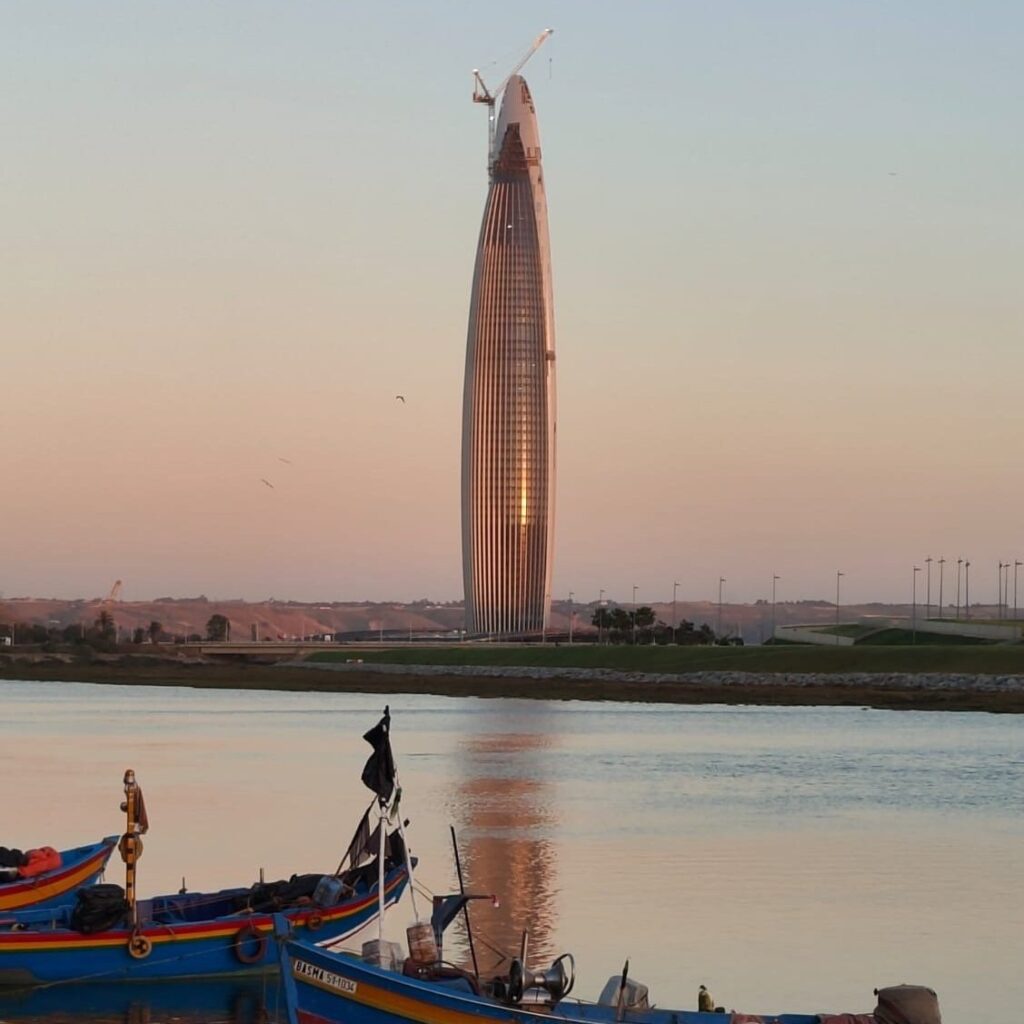
The tower is not the valley’s only landmark, nor its first attempt at architectural presence. Across the river, the unfinished minaret of the Hassan Tower has marked the site for centuries, its meaning drawn from age and history rather than height. Closer by, the Grand Théâtre de Rabat, designed by Zaha Hadid, proves that a building can command a skyline through sculptural form alone. The Mohammed VI Tower speaks a different architectural language, one built on scale and distance rather than form or history, entering into dialogue with what already exists rather than replacing it. What the tower adds to the valley, then, is not an icon it once lacked, but another way of being seen within a landscape.
Landmarks have traditionally emerged from the life of a city. Public squares, mosques, markets and civic buildings became reference points because people gathered around them before they admired them from afar. The Mohammed VI Tower reverses that relationship. It first establishes itself as a distant object in the skyline, leaving the harder architectural question unanswered: whether it produces an equally compelling place at ground level.
