Project details
Garden redevelopment and rehabilitation project
Landscape design firm: V comme vert
Location: Casablanca
Completion date: 2024
Client: La commune de Casablanca
Photographs: Chaimae Himdi
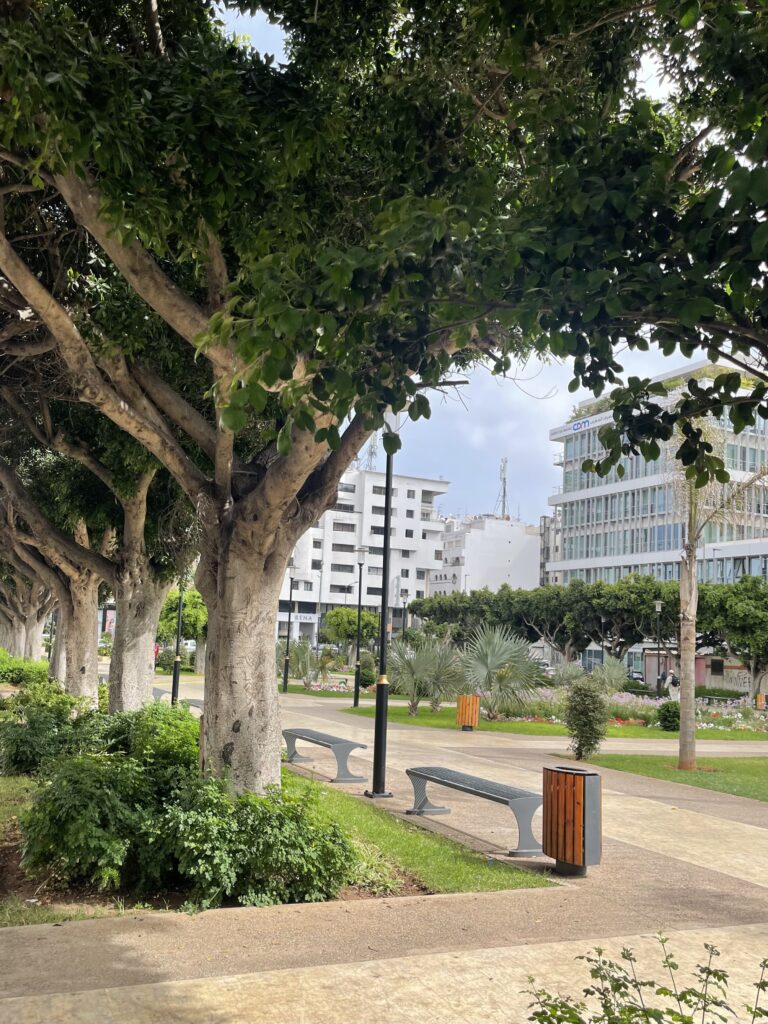
In the Maârif district of Casablanca, a small public garden occupies a plot of land with an unusually loud history. For nearly fifty years, the site held an arena hosting bullfights, boxing matches, and international concerts, before its demolition in 1971 that left the land vacant for decades. Today, following a 2024 renovation, it holds a quiet public garden. What sits between these two lives is an unresolved question: who is this space actually meant to bring together, and does its design reflect that?
An occupied vacancy
A vacant urban lot is never truly empty. Over its decades of abandonment, the site was not simply unused ground waiting for a plan; it was informally inhabited, appropriated by people the surrounding city offered no other place to be. This is a familiar condition in dense, land-scarce cities: an undesigned space, left without program or maintenance, becomes program by default. Its users write their own function onto it, long before an architect or planner arrives to write one officially.
This matters architecturally because it means the site was never a neutral canvas. When the renovation began, it was overwriting an existing, if informal, spatial order.
Designing over, not designing for
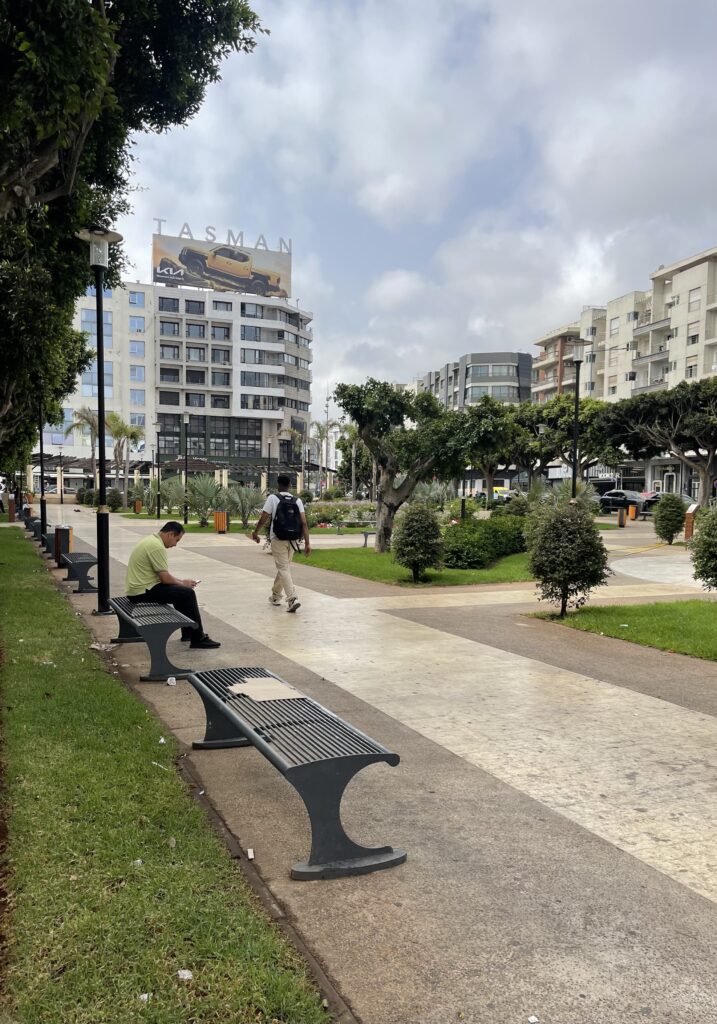
The renovation’s vocabulary is now familiar to anyone who has walked through a recently upgraded Moroccan public garden: paved paths, planted greenery, new lighting, rows of benches. Municipal framing described the project as reconciling heritage and green space for residents. What this vocabulary does not include is any visible acknowledgment of the site’s prior occupants, or any spatial strategy for how they and the neighborhood’s new users might now share the same ground.
This is where the design choices become legible as choices, not neutral upgrades. The garden’s seating is arranged for individual, transient use: benches spaced apart, oriented outward toward paths rather than inward toward each other, suited to sitting briefly or passing through rather than gathering. There are few, if any, spatial configurations that invite conversation, negotiation, or shared use, such as benches arranged in facing clusters, shaded seating areas sized for groups, or thresholds that ease movement between different zones of the garden. The layout instead produces a series of individual, self-contained positions within a shared field, an architecture of proximity without contact.
Two publics, one ground
The consequence is a garden now used by two distinct populations occupying the same physical space without any spatial mechanism to reconcile them. New residents drawn by the renovation use the garden as intended: a clean, legible, restful amenity. Its other public simply arrived alongside them, unannounced and unplanned for.
This coexistence is not unusual in itself. Public space regularly serves overlapping and even conflicting users. A garden that wanted to mediate this coexistence could do so through spatial means: zoning that allows different uses to coexist without friction, seating that scales from solitary to communal, sightlines that keep different areas legible and self-regulating rather than accidentally shared. None of this appears to have been considered. The garden was designed as though only one type of user existed, and the design’s blind spot is precisely where its two actual publics now meet.
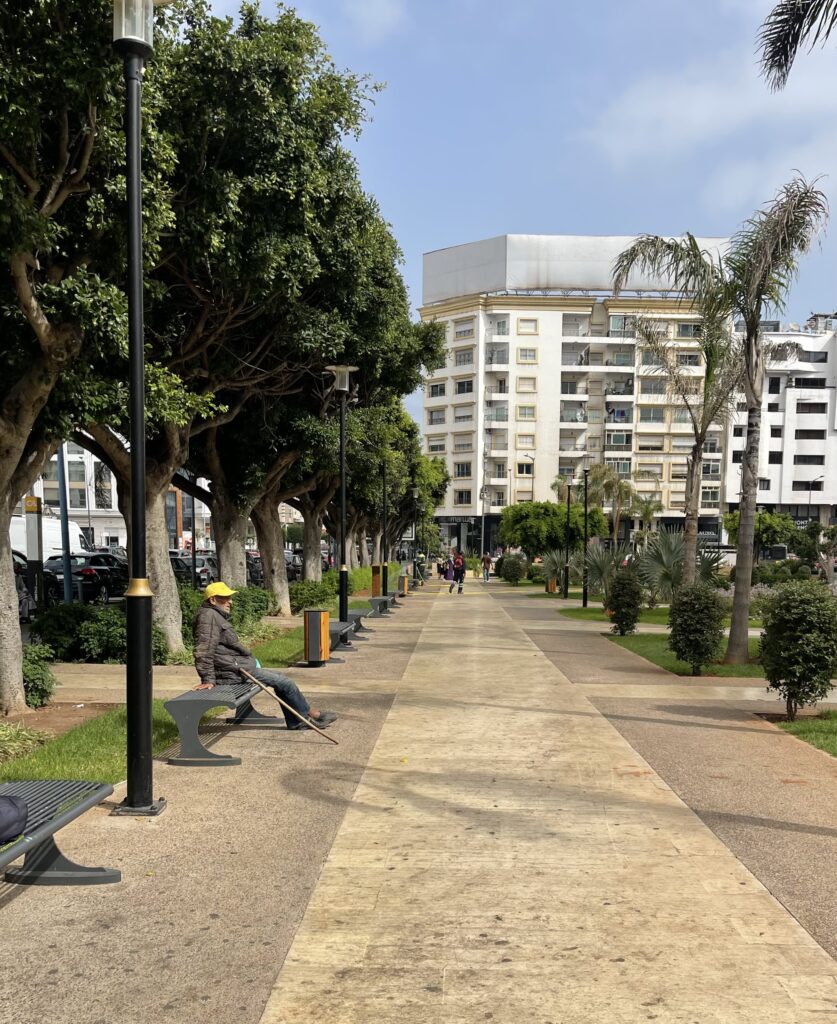
The Jardin des Arènes today is, by every visible measure, an improvement on the vacant lot it replaced. It is greener, better lit, more legible as a civic space. But the renovation solved a problem of surface, not of program. It reclaimed the land and introduced a new public without giving either group a spatial language for sharing the ground.
A public garden is defined by who is allowed to occupy it and how. The arena that once stood here knew exactly who it was for, and built accordingly. The garden that replaced it has yet to make the same decision.
