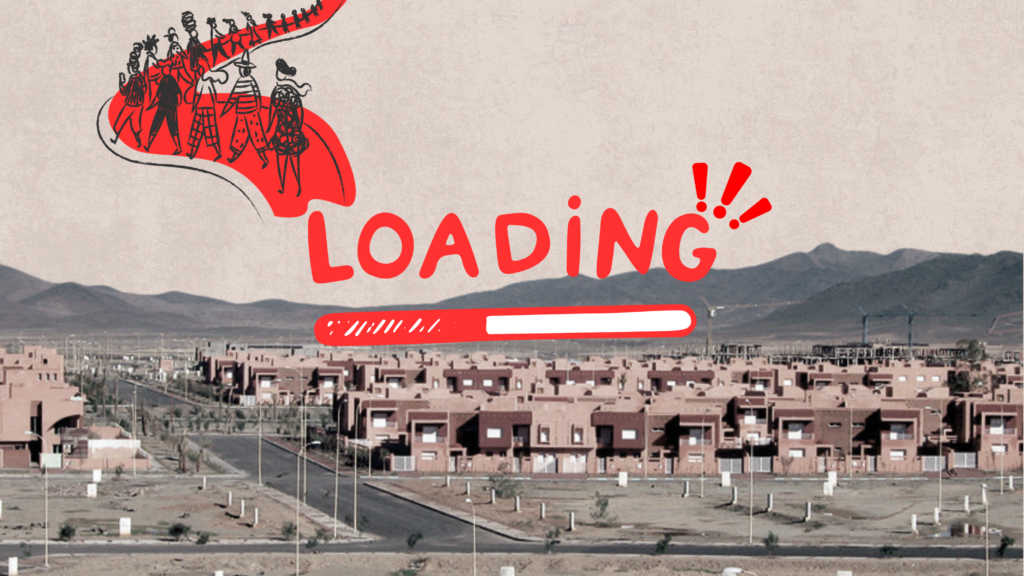
Across Morocco, new cities were planned as ambitious responses to uncontrolled urban expansion and speculative land development. Presented as alternatives to congested metropolitan areas, these projects promised self-sufficient communities, social diversity, sustainable growth, and a higher quality of urban life.
Despite these aspirations, many of these urban projects continue to struggle with weak economic activity, declining property values, and a persistent dependence on nearby metropolitan centers.
Having experienced daily life in Tamansourt firsthand, this essay examines why one of Morocco’s new cities failed to emerge as a thriving city and explores the strategies that could address its challenges.
1. Why Tamansourt failed to emerge as a new city
Metropolitan dependence and spatial isolation
Although conceived as an independent urban entity, Tamansourt developed largely as a residential extension of Marrakech. Rather than attracting a diversified economic base, the city became dependent on the metropolitan core for employment, higher education, healthcare, administration, and leisure.
This dependence generated a daily pattern of outward mobility in which residents commute elsewhere to access opportunities and services. As a result, local economic activity remains limited, reducing the capacity of the city to sustain its own urban dynamics. Instead of functioning as a secondary pole within the region, Tamansourt evolved into a dormitory settlement whose existence remains closely tied to Marrakech.
The city’s peripheral location is not inherently problematic; many successful satellite cities thrive through strong metropolitan connections. The issue lies in the absence of sufficient local functions capable of transforming proximity into autonomy.
The housing/services imbalance
The development strategy prioritized residential production, but the delivery of urban services failed to keep pace. Housing was treated as the primary indicator of success, while the facilities that support everyday life were often delayed, underprovided, or unevenly distributed.
In Tamansourt, the imbalance between residential growth and service provision weakened the attractiveness of the city and reinforced dependence on Marrakech.
An incomplete urban fabric
Beyond its functional challenges, Tamansourt continues to project an image of incompletion. Vacant plots, unfinished facilities, underdeveloped landscapes, and fragmented urban edges contribute to a perception of a city that remains under construction.
Urban coherence depends not only on infrastructure but also on continuity. Public spaces, streetscapes, landscaping, and civic landmarks contribute to the legibility and identity of a city. When these elements remain incomplete, residents experience the urban environment as provisional rather than established.
The gap between the planned city and the lived city remains visible in the physical fabric itself.
2. Rethinking development strategies for Tamansourt
Building a local urban identity
The future of Tamansourt depends on moving beyond the logic of housing provision toward the creation of place. Cities become meaningful when residents develop a sense of belonging rooted in shared experiences, collective memory, and recognizable public spaces.
This requires investment in cultural facilities, community programs, civic institutions, and public spaces capable of fostering social cohesion. Urban identity emerges through everyday use and collective appropriation of space.
The challenge is to transform Tamansourt from a place of residence into a place of attachment.
Activating the public realm
Revitalizing public life requires a more active and diverse public realm. Mixed-use development, ground-floor commerce, local markets, cafés, sports facilities, and cultural venues can introduce the density of activity necessary to animate streets and squares.
Rather than focusing on territorial expansion, future interventions should prioritize urban consolidation. Existing neighbourhoods must become more walkable, more connected, and more capable of supporting everyday social interaction.
The objective is not simply to provide public spaces, but to create spaces that attract people, encourage encounters, and generate urban life.
Integrating employment, services and mobility
For Tamansourt to evolve into a functioning city, employment, services, and mobility must be planned as a single urban system rather than as separate sectors.
Economic activity should be encouraged through the creation of business districts, educational facilities, innovation hubs, and spaces for entrepreneurship. At the same time, public transport connections must be strengthened to improve accessibility both within the city and across the wider metropolitan region.
The long-term objective is to reduce the structural dependence on Marrakech by creating conditions in which residents can live, work, access services, and participate in civic life within Tamansourt itself.
Tamansourt reveals the limits of a development model centred on urban growth rather than city-making. While its physical form was largely delivered, the social, economic, and spatial relationships that produce urbanity remained incomplete. The project demonstrates that a city is not defined by its buildings, but by the intensity of connections they support.
This essay reflects personal observations and a focused analysis of Tamansourt. For readers wishing to explore Morocco’s new cities in greater depth, I highly recommend the doctoral research of fellow architect Camilia Taibi El Kettani, whose work provides a rigorous and comprehensive study of the subject. https://theses.hal.science/tel-02525063v1/file/TAIBIELKETTANI.pdf
Interesting! I wonder if there are any successful projects of “villes nouvelles” in Morocco.
Tamesna, Chrafate, and Lakhyayta all illustrate similar challenges. While they have not fully achieved the ambitions they were initially designed for, it is perhaps more accurate to say they remain “in progress” rather than outright successes or failures.