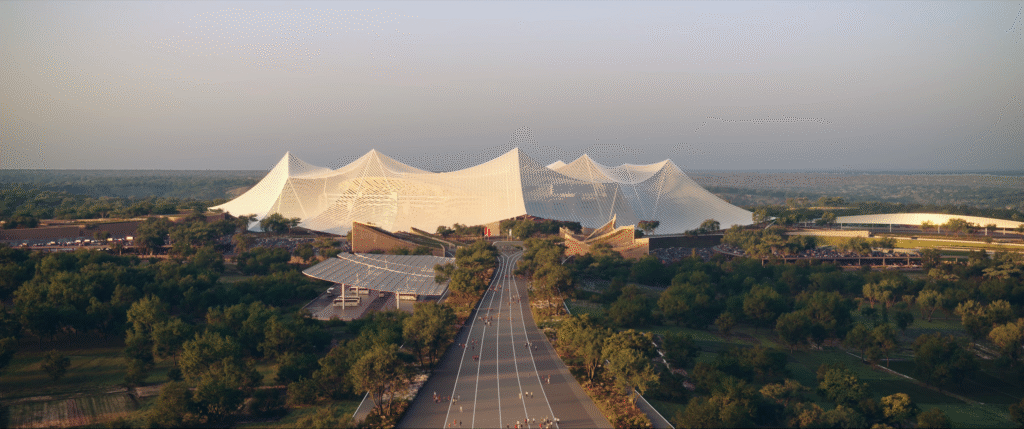
As Morocco prepares to host AFCON 2025 and co-host the 2030 FIFA World Cup, the country is undergoing an unprecedented transformation of its sporting infrastructure. Nine stadiums are being renovated, and three entirely new venues are planned ; including the highly anticipated Stade Hassan II, envisioned as one of the world’s largest stadiums.
Yet as an architect, I inevitably return to a deeper question: beyond the spectacle, what truly justifies building a stadium of this scale? Stadiums are not merely containers for events; they are urban decisions, spatial commitments that shape landscapes, mobility, and public life for decades. Before celebrating size, capacity, and global visibility, we must ask: what makes a stadium worth building from an architectural and urban perspective? And more specifically, does the new Stade Hassan II meet those standards?
What makes a stadium worth its urban footprint?
1. Integration into the urban fabric
A successful stadium does not exist apart from the city; it must connect to it. Meaningful integration requires:
• Accessible public transit and road networks
• Walkability and pedestrian links
• Proximity to mixed-use neighborhoods that support daily life
2. Life beyond match days
A modern stadium must function as a public space, not a dormant megastructure. Daily activation can be achieved through:
• Cafés, restaurants, and retail
• Public plazas and green spaces
• Spaces adaptable for community, cultural, or civic events
3. Contextual scale
The stadium’s scale must align with its surroundings. Size should reflect:
• Local population density and demand
• Infrastructure capacity
• Urban fabric’s ability to absorb large flows of people
4. Long-term sustainability
A stadium earns its legitimacy when it:
• Serves multiple purposes over time
• Contributes to future urban development
• Adapts to evolving social and spatial needs
Where does the stade Hassan II stand?
Located near the province of Benslimane, approximately 38 km north of Casablanca, the Grand Stade Hassan II occupies a 100-hectare site nestled within a forested landscape. Designed by Populous in collaboration with Oualalou + Choi, the stadium draws inspiration from the traditional Moroccan moussem: a place of gathering under a vast tent-like canopy. With a projected capacity of 115,000 seats, it aims to become one of the most iconic stadiums worldwide.
Yet the key to its success lies not only in its architectural gesture, but in the broader spatial strategy surrounding it. The stadium is no longer envisioned as an isolated mega-structure; it is positioned at the center of a territorial vision far beyond its own footprint.
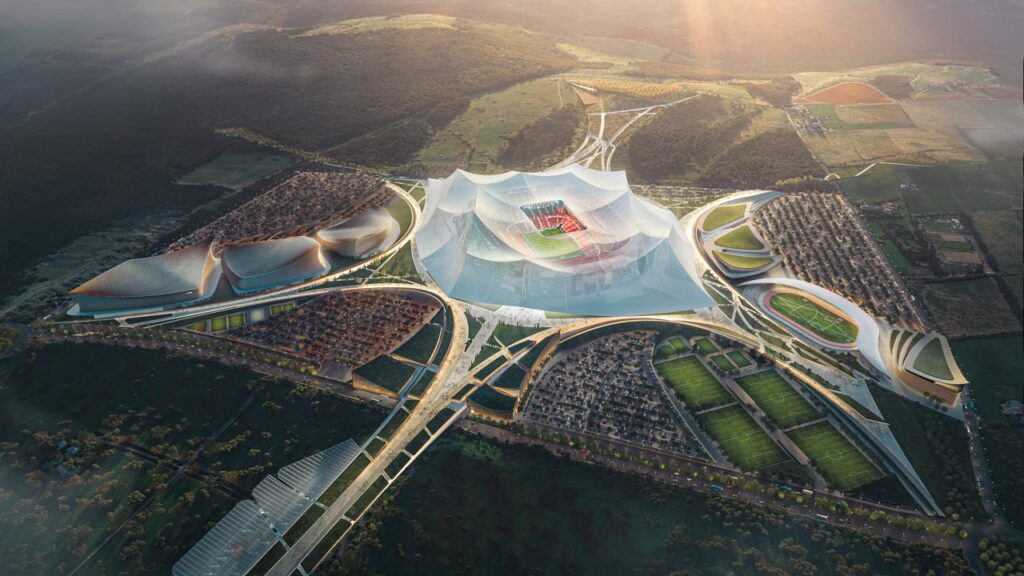
A territorial strategy for a new metropolitan hub
To ensure the stadium becomes a sustainable asset, the Ministry of National Territorial Planning and Urbanism has launched an international call for proposals to conduct a comprehensive territorial planning study for Benslimane. This marks a decisive step toward aligning the stadium with a long-term development model.
The study aims to:
• Coordinate and harmonize ongoing territorial projects
• Plan mobility, accommodation, health, and sports infrastructure
• Strengthen intercommunal cooperation
• Build a resilient, connected, and environmentally conscious urban model
Covering 60,000 hectares, including 20,000 hectares of forest, the study acknowledges Benslimane’s strategic position between Rabat and Casablanca. With major airports in close reach; Mohammed V Airport less than an hour away, and Benslimane Airport serving domestic flights; the location is well positioned for international accessibility while avoiding the spatial constraints of Morocco’s dense urban centers.
Urbanisme événementiel as a catalyst for transformation
The project embraces urbanisme événementiel: using major events as engines of territorial transformation. Rather than creating infrastructure for occasional use, the plan aims to leverage the World Cup to:
• Modernize the region
• Enhance natural and ecological assets
• Generate long-term economic opportunities
The stadium becomes not only a venue, but a metropolitan anchor, capable of shaping mobility networks, public spaces, and economic activity.
The question “is Morocco’s new stadium worth building?” cannot be answered by capacity figures or architectural renderings alone. A stadium of this scale must prove its worth through urban integration, longevity, and its ability to serve the community beyond match days. In the case of the Grand Stade Hassan II, the foundations for success are being carefully laid. The national commitment to a territorial coherence study, the strategic location between Rabat and Casablanca, and the strong emphasis on sustainable and smart urban development all point toward a project that seeks to transcend its event-based origins.