Project details
Architect: Frank Gehry
Location: Cultural District, Saadiyat Island, Abu Dhabi, UAE
Construction: Announced: 2006 — Opening: December 11, 2026
Form: Ten sculptural cones, up to 88m high, nine clad in stainless steel mesh, one in onyx and glass
Scale: 80,000 sqm total built area, the largest of the four Guggenheim locations
Client: Department of Culture and Tourism – Abu Dhabi, in partnership with the Solomon R. Guggenheim Foundation
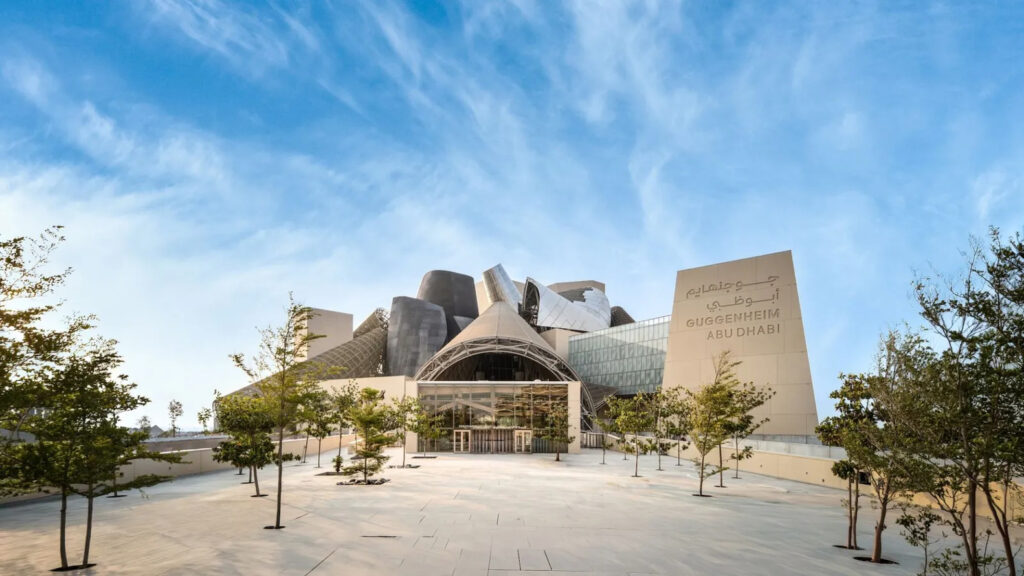
On December 11, 2026, the Guggenheim Abu Dhabi will open its doors twenty years after it was first announced. That gap between announcement and opening, and the fact that its architect did not live to cross it, is worth pausing on before getting to the building itself. Twenty years is long enough for an architectural “brand” to be tested, refined, and, arguably, perfected, and Abu Dhabi may be the clearest demonstration yet that what the Guggenheim exports today has less to do with any particular museum and more to do with a formula.
The making of a recognizable name
The Guggenheim’s first location, opened in New York in 1959, was designed by Frank Lloyd Wright and is best known for its spiral ramp. Visitors descend past the artwork along a single continuous path rather than moving gallery to gallery. It was already, in its own moment, an argument that a museum’s building could be as significant a work as anything hung inside it.
But it was Bilbao, in 1997, that turned this instinct into a repeatable formula. Gehry’s titanium-clad, sculptural museum did something no one fully expected: it took a project that played a pivotal role in redefining the relationship between architecture, city branding, and cultural tourism and turned a declining Basque industrial city into a global tourist destination almost overnight. Planners now have a name for this, the “Bilbao Effect”, shorthand for the belief that a single, sufficiently photogenic building can single-handedly reposition a city’s global image.
Abu Dhabi’s museum, opening this December, extends that formula into new territory. The largest Guggenheim in the network, designed once again by Gehry, whose sculptural silhouette carries an immediate visual link to Bilbao for anyone familiar with it.
Why the formula keeps working
The interesting question is why the same formula gets purchased again and again, by clients with entirely different needs. A struggling post-industrial Basque city and an oil-wealthy Gulf emirate building a cultural district from scratch have almost nothing in common; except that both, at some point, decided the answer was the same recognizable architectural signature.
That’s the real substance of “starchitecture” as a phenomenon: it is less about architectural innovation solved anew for each site, and more about a legible, transferable visual identity. A Gehry building doesn’t need to be uniquely responsive to Abu Dhabi’s climate, culture, or urban context to do its job. Its value to the client comes precisely from resembling Bilbao, from being instantly readable, on any skyline, as an object of global cultural significance. The building’s job is to be recognized.
This is the same instinct that runs through institutional architecture more broadly, wherever a client returns to a familiar visual language because that language has itself become a form of credibility.
What the building actually provides
What a franchise museum offers instead is closer to instant legibility: an internationally recognized name, attached to an internationally recognizable building form, that lets a new museum borrow decades of reputation instantly.
That’s not necessarily a criticism of the museum itself. But it does mean the building and the institution are doing two different kinds of work at once: one curatorial, and one closer to cultural diplomacy. Abu Dhabi’s cultural district: the Guggenheim alongside the Louvre Abu Dhabi and other internationally established institutions on Saadiyat Island makes that second function unusually visible, since so many recognized cultural names are being brought together, at considerable cost, in a single place at once.
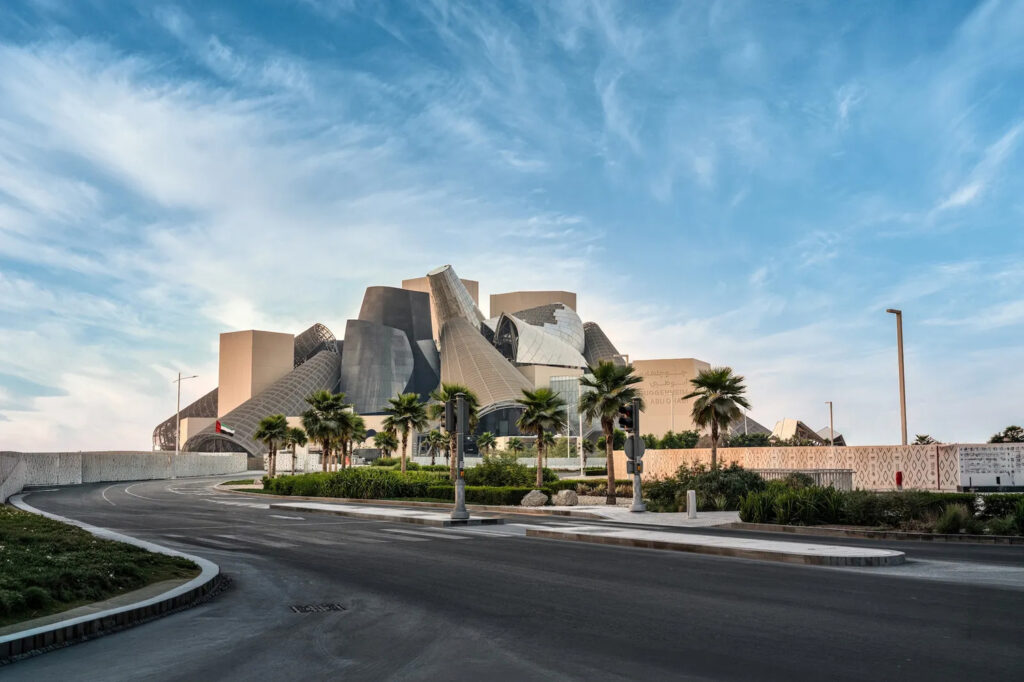
Two decades from announcement to opening is long enough that the building has already outlived its own architect. What isn’t yet answered is whether that same span of time is enough to turn a borrowed name into something genuinely rooted. Bilbao, in the end, became more than its own effect: a formula still produced a real, lasting institution. Whether Abu Dhabi’s more deliberate use of that same formula arrives at a similar place, or stays closer to its origins as a striking silhouette, is the question this opening can’t answer yet.