The case of Avenue Royale in Casablanca, Morocco.
Urban development projects are often conceived from a strategic, institutional perspective. Planned by public authorities and urban professionals, they aim to improve the city through objectives such as modernization, mobility, or economic development, and are typically justified in the name of the public interest.
Yet cities are not only planned, they are lived. The areas targeted for transformation are inhabited by communities whose daily lives are shaped by that built environment. The case of Avenue Royale in Casablanca, Morocco, highlights this tension between planning from above and living the project, raising the question of how public ambitions intersect with the interests of local communities.
1. The Avenue Royale project
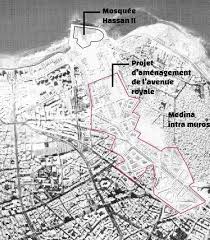
Source : Dossier Avenue royale, reconversion de ville dans AM – architecture du Maroc, N. 10. Mars/av
The Avenue Royale project is an urban development initiative launched in 1995. The rehousing process was one of the major challenges that delayed its implementation.
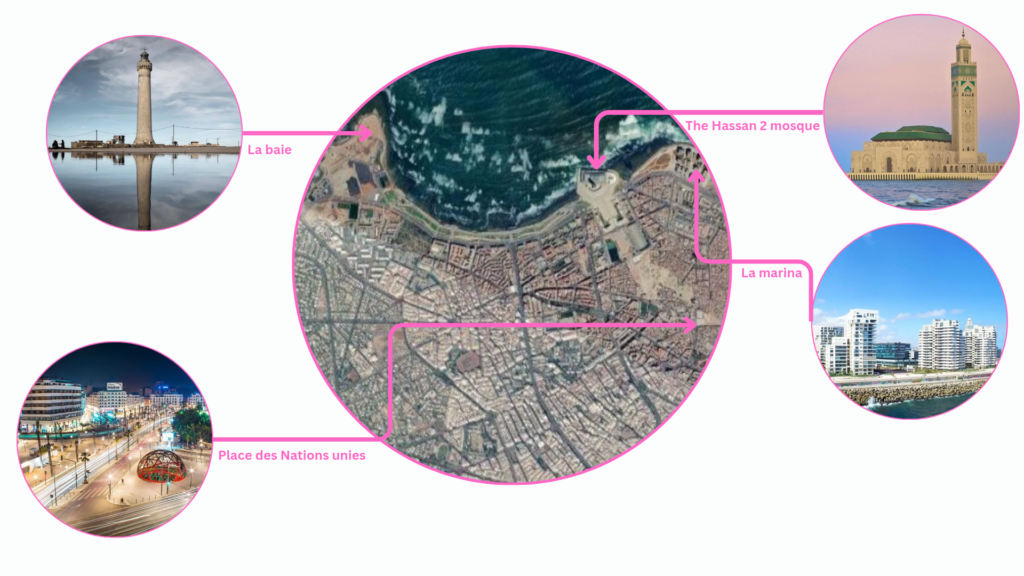
The project consists of the opening of a new urban axis, 1,300 meters in length and 60 meters in width, linking the Great Mosque of Hassan II to the center of Casablanca, namely Place des Nations Unies.
The project has two main components. The first focuses on urban development, modernization, and internationalization. The second addresses the eradication of substandard housing and unhealthy living conditions.
The debate therefore concerns less the project’s ambitions than the relocation solutions proposed to replace the deteriorated housing.
2. The authorities’ perspective
The project seeks to establish a high-end private development in Casablanca, including office spaces dedicated to tertiary activities, as well as a theatre and a congress palace. This reflects the ambition of economic upgrading, modernization, and enhanced international visibility.
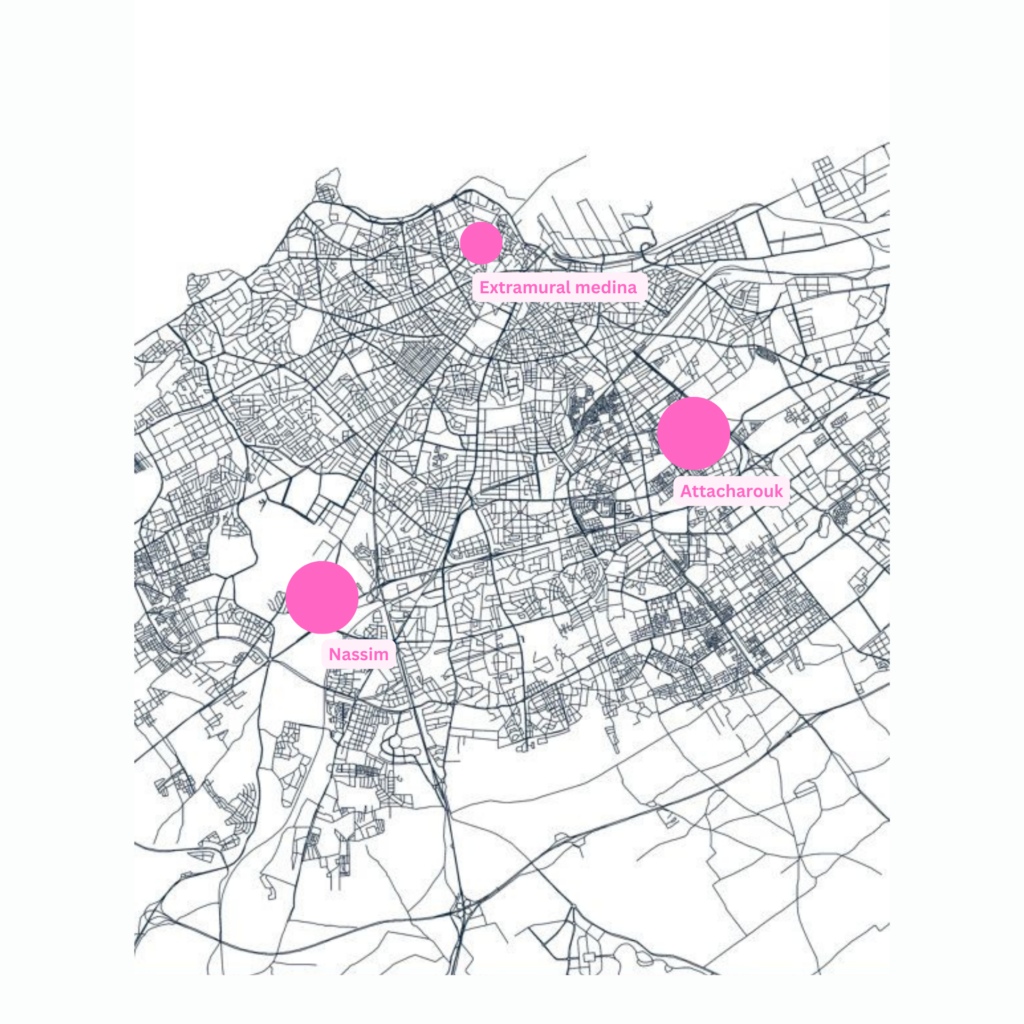
The residential fabric located within the project’s intervention zone is in the area of the extramural medina. It is marked by unsafe buildings and inadequate living conditions.
In accordance with Article 3 of Law 7/81, public interest prevails over private interests in such cases. Within this legal framework, the urban development agency SONADAC proposes relocation measures by granting affected families access to homeownership and financing two-thirds of the cost of new apartments.
By providing access to new housing that is structurally sound and replacing dwellings classified as unsafe, the authorities position relocation as a form of compensation for the affected households. The financial support covering two-thirds of the new housing cost represents a significant public investment in mitigating displacement.
Given that the project is located in a strategic and high-value area, near major urban landmarks such as the mosque Hassan II and surrounded by high-end developments such as La Marina and La Baie de Casablanca, the transformation of this territory generates substantial added value. In this context, relocation measures can be interpreted as part of a broader redistribution mechanism linked to urban upgrading.
3. The local community’s perspective
The relocation is implemented in two areas: Nassim, located approximately 15 km from the original housing site, and Attacharouk, located around 12 km away.
Several families express dissatisfaction with the compensation and housing solutions proposed by the SONADAC. The following points reflect their main concerns:
1. Financial constraints remain a major issue. The cost of an apartment in Nassim is approximately 200,000 MAD, with a remaining balance of around 70,000 MAD after public support. Even with a monthly repayment plan of 450 MAD, this amount remains difficult to afford for many households. Families who are not officially registered in the census face an even heavier burden, as they are required to pay the full price without financial assistance.
2. Relocation to the periphery has significant spatial and socio-economic consequences. Living far from the city center increases transportation costs and utility expenses, while also limiting access to employment opportunities and urban services. The shift to peripheral areas therefore alters not only the physical location of households but also their economic and daily mobility conditions.
3. The proposed housing typologies do not fully correspond to the existing modes of living in the extramural medina. The traditional spatial organization of multi-storey houses allows for autonomy within extended families living under the same roof. This configuration supports intergenerational cohabitation and enables even two to three different families to share one dwelling while maintaining relative independence. In contrast, the new apartment models limit such spatial flexibility.
Both tenants and property owners expressed difficulties with the relocation arrangements proposed. Landowners, however, were more favorable to the project. Rental revenues had remained low for a long period and had not been updated, which limited the profitability of the existing properties.
Ultimately, the population’s opposition does not seem to be directed at the project itself. Rather, it concerns the solutions proposed to them and the conditions under which relocation is implemented.
The Avenue Royale project reveals a strong tension between the pursuit of public interest and the needs of the populations directly affected by redevelopment. Rather then framing the issue as a simple opposition between development and resistance, it invites a broader discussion on what alternative or innovative solutions could better reconcile urban transformation with the social realities of the communities involved.
This article draws on research conducted by architect Fatima Zahra Ben, on the Avenue Royale project.
